
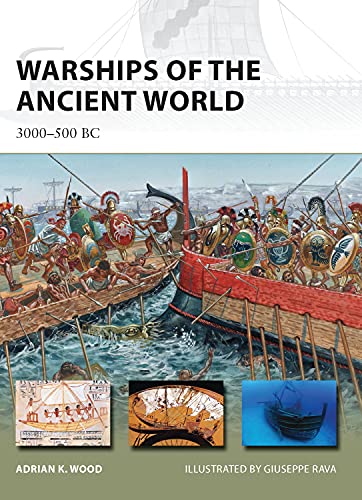
Warships of the Ancient World: 3000–500 BC (New Vanguard, 196)


Description
- Reference Book
- Warships of the Ancient World 3000-500 BC New Vanguard #196 by Adrian K. Wood Osprey
The world's first war machines were ships built two millennia before the dawn of the Classical world. Their influence on the course of history cannot be overstated since they allowed war to be carried to distant lands, allowing for the first time the rise of empires unrestricted by maritime boundaries. The same ships enabled early Mediterranean nations to explore the Atlantic and Indian Oceans and circumnavigate Africa, while leaving a significant impact on the culture and military thought of later civilisations.
The famed triremes and penteres of the Classical world were the result of centuries of technological advance and experience. A wide variety of galleys and other types of warships were built by successive civilisations, each with their own distinctive appearance, capability and utility. The earliest of these were the Punt ships and the war galleys of Egypt which defeated the Sea People in the first known naval battle, along with the contemporary ships of Minoan Crete, the first sea power. Following the fall of these civilisations, the Phoenicians built biremes and other vessels with which they created the first Mediterranean-wide trade empire, while in Greece the ships described in detail in the 'Trojan' epics established a tradition of warship building culminating in the pentekonters and triaconters which allowed the Greeks to compete for hegemony on the seas.
The warships of the period are abundantly illustrated on pottery and carved seals, and depicted in inscriptions and on bas-reliefs. A number of ships have also been excavated, from Egypt to Sicily, along with marine artefacts such as anchors and a bronze ram, while there are numerous finds of armour and weapons of the types used by naval personnel in this era. To this material evidence can be added literature from such disparate sources as Homer, the Old Testament and the Classical world's first historians.
The subject has been intensively studied for two and a half millennia, culminating in the contemporary works of authoritative scholars such as Morrison, Wallinga, Rodgers and Casson. Finally there are a number of modern reconstructions, both virtual and real, which have shed new light on the technology and usage of vessels of this period.
To date there are no works covering this subject which are accessible and available to non-academics. This can only be considered a serious oversight due to the importance of this fascinating period.
Technical Specifications
Shipping & Delivery
Your order is shipped from the USA and delivered to your door in South Africa in 10–20 working days. All items are fully tracked.
Returns & Exchanges
We offer a 30-day return window. If something isn't right, contact our support team and we'll make it right.