
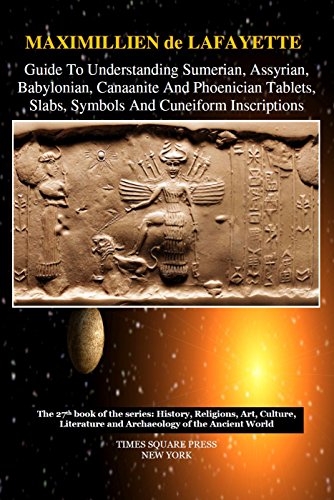
Guide To Understanding Sumerian, Assyrian, Babylonian, Canaanite And Phoenician Tablets, Slabs, Symbols And Cuneiform Inscriptions
Description
Guide To Understanding Sumerian, Assyrian, Babylonian, Canaanite And Phoenician Tablets, Slabs, Symbols And Cuneiform Inscriptions. The 27th book of the series: History, Religions, Art, Culture, Literature and Archaeology of the Ancient World. Published by Times Square Press, New York.
This series of 27 books on the history, religions, art, culture, literature and archaeology of the ancient world is a monumental work.
It is conceived and written for the use of universities' professors, teachers of art history and history of ancient civilizations, as well as for students and researchers in the field. In this series, the author explains the meaning, the message and structure of hundreds upon hundreds of Mesopotamian, Phoenician, Ugaritic and ancient Middle and Near Eastern tablets, slabs, seals, obelisks, and cuneiform inscriptions.
It was said, "A picture is worth a thousand words." True, very true! But what if a picture is hard to understand or does not explain what we are looking at?
This happens quite often in the vast literature and history of ancient civilizations. Especially, when the inscriptions on or under the pictures or illustrations are written in a language we do not understand, such as Cuneiform, Ugaritic, Akkadian, Sumerian, Phoenician, and similar writing systems of the ancient Middle and Near East.
In addition, there are thousands of slabs, cylinder seals, tablets, and obelisks of ancient and/or vanished civilizations, which are hard to decipher.
And in many instances, no pertaining inscriptions or texts were ever provided to explain what the statues, figurines, slabs and tablets represent.
To fully understand the scriptures, texts, epics and literature of Mesopotamia, Sumer, Assyria, Chaldea, Phoenicia, and Ugarit, one must become familiar with the meaning (Hidden or revealed) of the inscriptions, the symbolism camouflaged in intricate details, and the religious-artistic-philosophical nuances of the art of the era.
It also requires familiarity with historical sites, ruins, and cities, and a perfect knowledge of the ancient languages and dialects of the ancient civilizations of the Near East, and the Middle East, and multiple linguistic analogies.
This book was written in order to deal with and to explain all these concerns, and above all to provide the readers with sufficient guidance, translation and explanation of major archaeological finds, ranging from a figurine to a massive monument.
This book was written by an expert linguist, who has authored several dictionaries and encyclopedias of ancient and dead languages, translated and explained numerous Mesopotamian, Phoenician, Ugaritic, Canaanite and Middle/Near Eastern tablets and cuneiform texts.
Simply put, "Guide To Understanding Sumerian, Assyrian, Babylonian, Canaanite And Phoenician Tablets, Slabs, Symbols And Cuneiform Inscriptions" is a literary gem.
Example of an entry from this precious book, and how the author explained the illustrations (Slabs, seals, inscriptions, statues, artifacts):
ENTRY: AKKADIAN INSCRIPTIONS OF THE ANUNNA (DEITIES) IN ORDER OF SENIORITY, AND THE SYMBOL OF DIVINITY.
Explanation: A cuneiform Akkadian clay tablet circa 2400-2200 B.C., Sumer, listing gods and goddesses in order of seniority: Enlil, Ninlil, Enki, Nergal, Hendursanga, Inana-Zabalam, Ninebgal, Inanna, Utu, Nana. The sign/symbol appearing in the first row (Very top) on the left represents a cuneiform inscription of "Dingir". See on the next page an enlarged picture of the symbol, and meanings.
Illustration Above: Enlarged inscription-form of Dingir from the Akkadian-Sumerian clay tablet, circa 2400-2200 B.C. It is used as a symbol, indication and reference to the deity status of a personage. For instance, Anu Dingir means God Anu. The sign in Akkadian, and Old Babylonian was always used as a determinative sign next to the name of gods and goddesses, in order to refer to their divinity status. etc....
Shipping & Delivery
Your order is shipped from the USA and delivered to your door in South Africa in 10–20 working days. All items are fully tracked.
Returns & Exchanges
We offer a 30-day return window. If something isn't right, contact our support team and we'll make it right.