
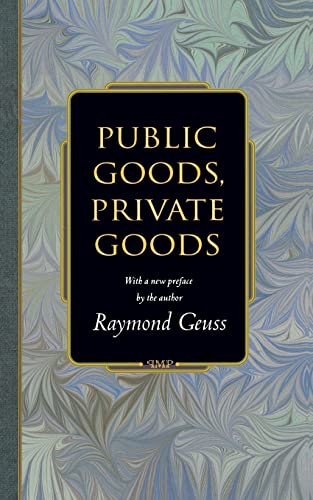
Public Goods, Private Goods (Princeton Monographs in Philosophy)
Product Description
Public Goods, Private Goods (Princeton Monographs in Philosophy)
Much political thinking today, particularly that influenced by liberalism, assumes a clear distinction between the public and the private, and holds that the correct understanding of this should weigh heavily in our attitude to human goods. It is, for instance, widely held that the state may address human action in the ''public'' realm but not in the ''private.'' In Public Goods, Private Goods Raymond Geuss exposes the profound flaws of such thinking and calls for a more nuanced approach. Drawing on a series of colorful examples from the ancient world, he illustrates some of the many ways in which actions can in fact be understood as public or private.
The first chapter discusses Diogenes the Cynic, who flouted conventions about what should be public and what should be private by, among other things, masturbating in the Athenian marketplace. Next comes an analysis of Julius Caesar's decision to defy the Senate by crossing the Rubicon with his army; in doing so, Caesar asserted his dignity as a private person while acting in a public capacity. The third chapter considers St. Augustine's retreat from public life to contemplate his own, private spiritual condition. In the fourth, Geuss goes on to examine recent liberal views, questioning, in particular, common assumptions about the importance of public dialogue and the purportedly unlimited possibilities humans have for reaching consensus. He suggests that the liberal concern to maintain and protect, even at a very high cost, an inviolable ''private sphere'' for each individual is confused.
Geuss concludes that a view of politics and morality derived from Hobbes and Nietzsche is a more realistic and enlightening way than modern liberalism to think about human goods. Ultimately, he cautions, a simplistic understanding of privacy leads to simplistic ideas about what the state is and is not justified in doing.
Technical Specifications
You might also like

Outside Ethics

Reality and Its Dreams

Politics and the Imagination

Philosophy and Real Politics

The Language Animal: The Full Shape of the Human Linguistic Capacity
History and Illusion in Politics

On the People's Terms: A Republican Theory and Model of Democracy (The Seeley Lectures)

Secularism Confronts Islam
The Importance of What We Care About: Philosophical Essays

Ethics and the Limits of Philosophy