
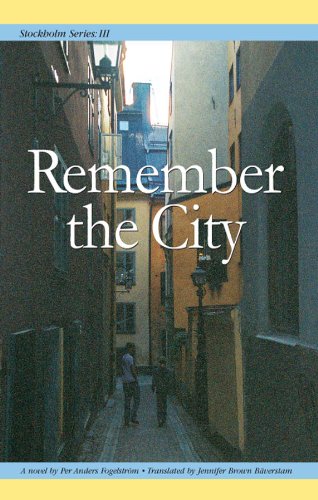
Stockholm Series III: Remember the City

Product Description
Stockholm Series III: Remember the City
Third in a series, this book tells the continuing tale of the growth in the underclass of nineteenth-century Stockholm into a modern European metropolis. The new century had dawned; the new era had arrived. But the city was still just an overgrown small town. Much of the idyllic country life still existed alongside rumbling factories and newly constructed office buildings. White sails of small cargo boats rimmed the waters, rattling carts rolled over endlessly empty squares, the echo of horses’ hooves pounded between the buildings on bleak wide streets.
Beneath the calm surface the birth pangs of modernization were underway. On the desolate streets the processes of transformation were carried out so fast and so radically that many city dwellers felt turned into strangers in their own home.
In every part of the city there was construction going on: apartment houses, tall churches and stately schools. New streets were laid out, wide boulevards where recently planted young trees stuck up out of a sea of sand. A ring of residential suburbs grew up outside the old tollgates. The last horse-drawn streetcars disappeared; the first car showroom was opened. Electricity and the internal combustion engine were ready for use in continued dramatic changes to the city and to life.
So much of the known and the familiar were destroyed. Buildings were torn down, hills blasted away, gravestones and the bones of the dead were tossed aside. Nothing was considered sacred or worth preserving.
They were going toward brighter times; such was the law of development, the doctrine of progress. Behind lay only darkness and want, days to forget, memories to obliterate.
A new century, a new city. And a new human being?
Per Anders Fogelström’s Stockholm Series is a quintet of novels about the intertwined stories of a city and of a family; this third volume, Remember the City, focuses on the experiences and diverging destinies of the children of Henning Nilsson. The research behind and within Fogelström’s series is prodigiously detailed: he gives us meticulous descriptions of landscapes, weather, rooms, streets, factories, cafes, bars, and emerging landmarks; he knows and understands the historical events, issues, politics of the period 1880–1900 in this second volume, which of them were remote from the working classes, and which were immediate. He tells his stories without contrivance; when there are life-changing events, they erupt into a context of daily life that he conveys no less compellingly. He can show us the clothes his characters are wearing, tell us how these people smell, describe the effect of alcohol and toil on their bodies. Most of all he understands their values, their ideals, their emotions, their human integrity; he admires their enduring strengths, and views their weaknesses with compassion. Jennifer Brown Bäverstam’s skillful translation is at once transparent and rooted, like its source. The author, Per Anders Fogelström, is one of the most widely read authors in Sweden today. 362 pages

